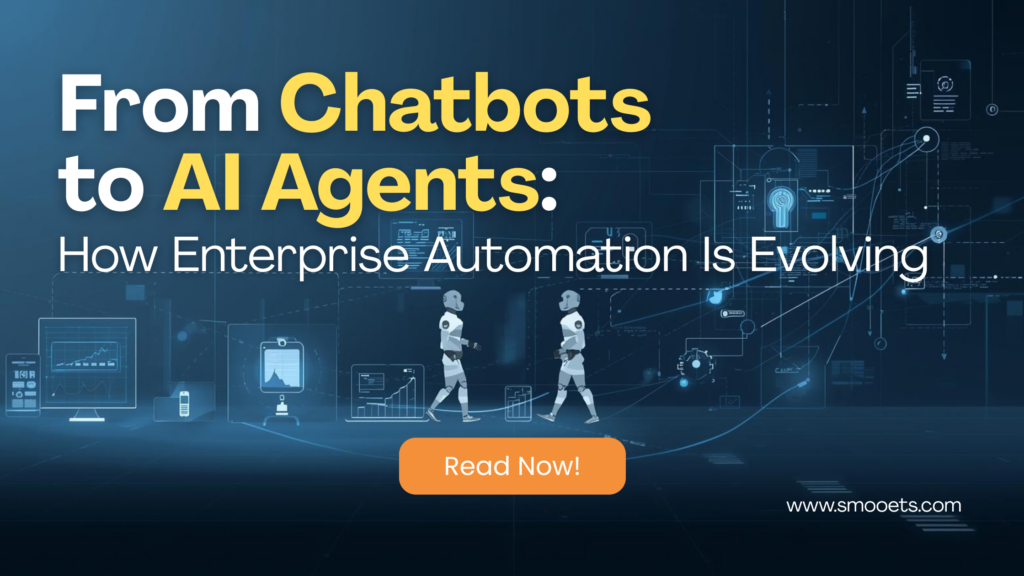
Automation Is No Longer About Efficiency, It’s About Decisions
For more than a decade, enterprises have invested heavily in automation.
From RPA bots to workflow engines, the goal was clear: reduce manual work, improve efficiency, and standardize processes.
And it worked up to a point.
By 2026, however, a fundamental shift is underway. Automation is no longer just about executing predefined steps. It is increasingly about making decisions, coordinating systems, and acting autonomously.
This is where AI agents enter the picture.
AI agents are not simply “smarter bots.” They represent a different automation paradigm, one that forces enterprises to rethink architecture, governance, and operational maturity.

From Workflows to AI Agents: What Actually Changed?
Traditional automation relies on workflows:
- Predefined steps
- Explicit rules
- Deterministic behavior
Workflows are excellent when:
- Processes are stable
- Inputs are predictable
- Exceptions are limited
AI agents operate differently.
An AI agent is a system that:
- Understands context
- Chooses actions dynamically
- Uses tools, data, and models to pursue a goal
Instead of following a fixed path, an agent decides what to do next based on the situation.
A simple way to think about it:
Workflows execute instructions.
AI agents pursue outcomes.
This shift from instruction-driven to goal-driven automation is what makes AI agents powerful and risky if unmanaged.
Why AI Agents Are Gaining Momentum in 2026
AI agents are not a hype trend. Their rise is driven by real enterprise pressures.
1. Increasing System Complexity
Modern enterprises operate across:
- Dozens of SaaS tools
- Hybrid cloud environments
- Fragmented data sources
Rigid workflows struggle to orchestrate across this complexity. Agents, by contrast, can dynamically choose tools and paths.
2. Advances in AI Capabilities
Large language models, multimodal AI, and tool-calling capabilities have made agents far more capable:
- Understanding intent
- Reasoning across context
- Acting across systems
What was experimental a few years ago is now production-ready.
3. Demand for Speed and Adaptability
Markets move faster than workflows can be redesigned. Enterprises need systems that adapt without constant re-engineering.
AI agents offer adaptability but only when designed correctly.
The Limits of Workflow-Based Automation
Despite their success, workflows are showing their limits.
Fragility at Scale
As workflows grow:
- Edge cases multiply
- Maintenance costs rise
- Failures cascade
Every exception requires new rules.
Poor Handling of Ambiguity
Workflows assume clarity. Real-world operations rarely provide it.
High Operational Overhead
Keeping workflows updated requires continuous manual intervention.
Key insight:
Workflows scale tasks. They don’t scale decision-making.
AI Agents as Decision Orchestrators
AI agents shift automation from task execution to decision orchestration.
A mature AI agent can:
- Interpret context across systems
- Decide which tools to use
- Sequence actions dynamically
- Escalate to humans when needed
This makes agents ideal for scenarios where:
- Information is incomplete
- Conditions change frequently
- Decisions matter more than steps
However, this power introduces a new challenge: control.
The Hidden Risk: Agent Sprawl
Many enterprises experimenting with AI agents are encountering a new problem: agent sprawl.
Symptoms include:
- Too many agents with overlapping responsibilities
- Inconsistent behavior across teams
- Rising compute and API costs
- Unclear accountability when things go wrong
Without structure, agents can quickly become:
- Unpredictable
- Hard to audit
- Difficult to govern
More agents do not equal higher maturity.
They often signal the opposite.
What Enterprises Must Rethink to Reach Automation Maturity
To move from experimentation to maturity, enterprises must rethink several fundamentals.
1. Architecture: From Pipelines to Orchestration Layers
Agents need:
- Clear orchestration frameworks
- Defined tool boundaries
- Observability across actions
Without this, agents operate in isolation.
2. Governance: Designing Human-in-the-Loop by Default
Not every decision should be autonomous.
Mature systems define:
- When agents act independently
- When humans approve or override
- How decisions are logged and reviewed
3. Data & Observability
Agents are only as good as the signals they receive.
Enterprises need:
- Reliable data pipelines
- Monitoring for drift and failure
- Clear performance metrics tied to outcomes
4. Operating Model
AI agents change how teams work.
Responsibilities must be clarified:
- Who owns agent behavior?
- Who is accountable for outcomes?
- How are changes tested and deployed?
Automation maturity is as much an organizational challenge as a technical one.
Practical Enterprise Use Cases for AI Agents
When implemented responsibly, AI agents unlock significant value.
IT Operations
- Incident triage and resolution
- Automated diagnostics across systems
- Smart escalation to engineers
Customer Support
- Context-aware issue resolution
- Intelligent routing and follow-ups
- Reduced handoffs between channels
Supply Chain & Operations
- Dynamic coordination across vendors
- Exception handling in real time
- Adaptive planning under uncertainty
Internal Knowledge & Productivity
- Agents that retrieve, synthesize, and act on internal information
- Reduced dependency on manual searches
In all cases, success depends on orchestration, not autonomy for its own sake.
Building AI Agents Responsibly
Responsible agent design follows a few core principles.
Start With Constrained Autonomy
Begin with clear boundaries and expand gradually.
Define Goals, Not Just Tasks
Agents need explicit success criteria aligned with business outcomes.
Measure Outcomes, Not Activity
Track impact, not just actions taken.
Design for Explainability and Control
Agents must be observable and auditable — especially as autonomy increases.
Why Strategic Partners Matter
AI agents touch multiple dimensions:
- Technology
- Governance
- Operations
- Risk
Very few organizations can address all of these alone.
A strategic AI partner helps enterprises:
- Avoid pilot purgatory
- Design scalable agent architectures
- Balance speed with safety
At Smooets, we approach AI agents as part of an end-to-end lifecycle from strategy and architecture to building and maintaining agent ecosystems that remain reliable as they scale.
The Future of Automation Maturity
In 2026, automation maturity will no longer be measured by:
- Number of bots
- Number of workflows
It will be measured by:
- Decision quality
- System adaptability
- Governance and trust
AI agents are redefining what automation means, but only for enterprises ready to rethink how automation is designed, governed, and scaled.
Final Thought
AI agents are replacing workflows, not because workflows failed, but because business complexity outgrew them.
Enterprises that treat AI agents as “smarter automation” will struggle.
Those that treat them as decision systems will build a real advantage.
If your organization is moving beyond basic automation, now is the time to assess whether your architecture and governance are ready for AI agents before complexity outpaces control.